Available now · Web · iOS · Android
Expert Buffer Designer
Design, understand, and de-risk any buffer. Model pH and ionic strength from first principles, build single- or dual-species recipes, and see exactly how robust a buffer is — before you ever weigh a reagent.
See it in action
From a request to a recipe
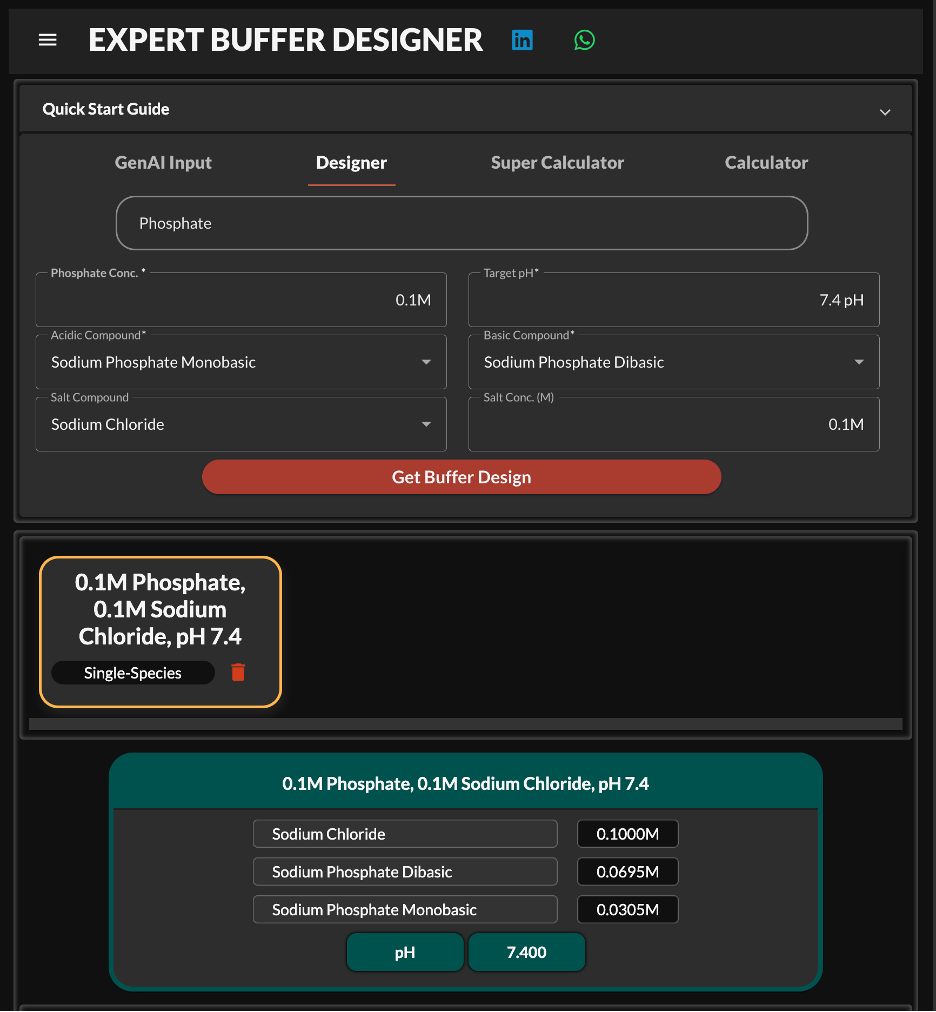
Ask for "0.1 M phosphate, 0.1 M sodium chloride, pH 7.4" and the engine returns the exact recipe — Sodium Phosphate Monobasic and Dibasic balanced to land on pH 7.400, with sodium chloride for ionic strength.
Every result is fully characterized: compounds, ions, and ionic species, plus the sensitivity heat-map that shows how robust the buffer is across the working range.
No buffer too complex
The most complex buffer, made simple
Mix two buffer species, a base, and a salt — and let the engine solve the whole system at once, or auto-adjust to a target pH. The kind of multi-component buffer that's painful to reason about by hand, designed in a few clicks.
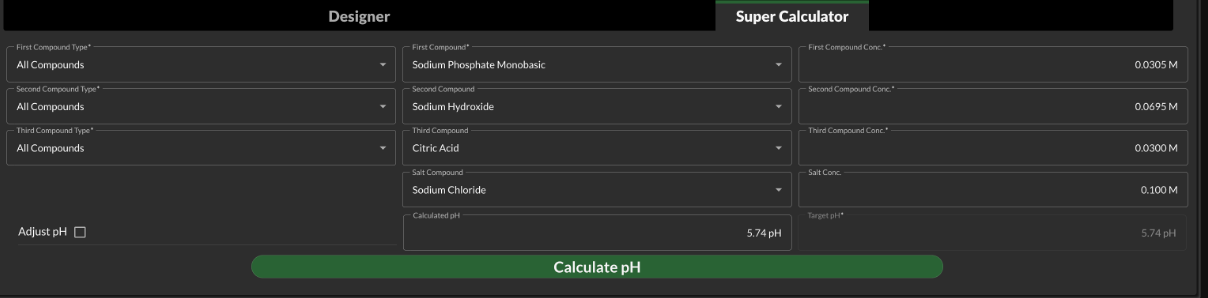
Sodium Phosphate Monobasic and Citric Acid (two buffering species), with Sodium Hydroxide and Sodium Chloride — four components solved together to a predicted pH of 5.74.
Designed for robustness
Stress-test a buffer before you scale
The sensitivity heat-map perturbs each compound across ±10% and predicts the pH at every point — so you can see how forgiving a formulation is and choose a robust one on purpose, not by luck.
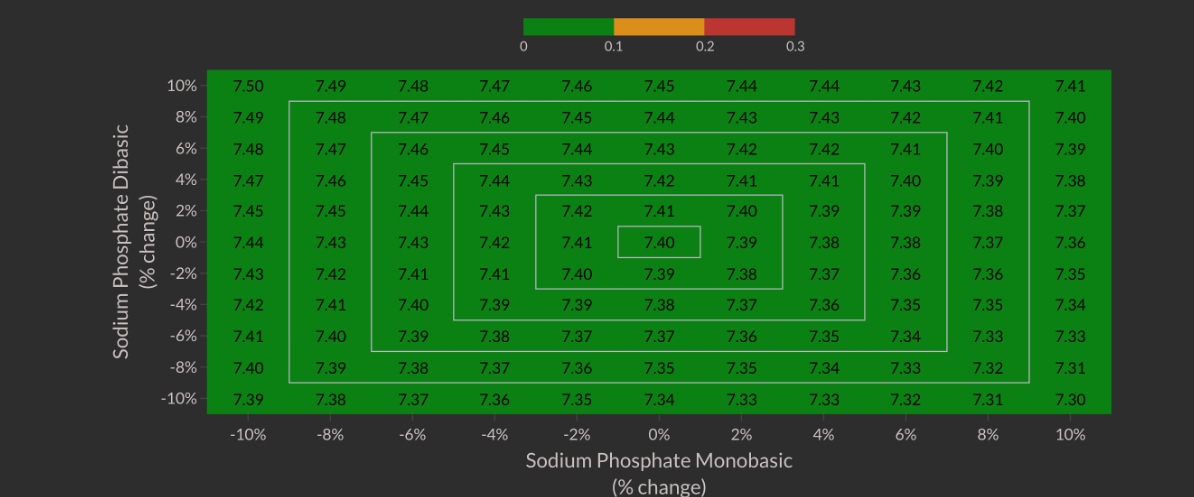
Each cell is the predicted pH when the two phosphate compounds are off by the row and column amounts. Green means the pH barely moves; amber and red flag fragile formulations. Here the buffer holds within 0.1 pH units even at ±10% — a robust choice for the plant.
What it does
Buffer design, backed by the chemistry
Ionic-strength-aware pH
Goes beyond Henderson–Hasselbalch: models how ionic strength shifts each species' pKa, so the predicted pH matches what you actually measure.
Single & dual buffer species
A library of Good's, biochemical, and standard buffers — alone or as dual-species systems — with full composition and ion detail.
±10% sensitivity heat-map
A color-coded map shows how much pH drifts under ±10% concentration error across the range — find the robust working zone before you scale up.
Natural-language entry
Type "50 mM phosphate, pH 7.4" and the app builds the recipe — GenAI-assisted input that speaks the way scientists do.
Your personal buffer library
Save, name, and reuse buffers; everything syncs to the cloud across sessions and devices. Sign in with Apple or Google.
Anywhere you work
Runs in the browser as a web app, and natively on iOS, iPad, Android, and Mac — bench, desk, or phone.
Why it matters
Buffers are the backbone of every process step
Equilibration, wash, elution, viral inactivation, UF/DF, formulation — nearly every unit operation in biologics manufacturing runs on a buffer. A pH or ionic-strength miss doesn't just cost a re-prep; it can shift chromatography selectivity, stress a product, or stall a campaign.
Designing buffers in software — and stress-testing their robustness — turns a trial-and-error bench task into a predictable, documented decision. That's the whole idea behind the suite.
From the literature
The method, published
The buffer-design approach behind the app is documented in a peer-reviewed trade journal — built on decades of downstream-process practice.
Buffer Design for Biopharmaceutical Processes
An online tool for designing and understanding buffers — buffer chemistry, a three-step design workflow, and robustness analysis. Featured report, Jul–Aug 2024.
Read the article →Decades of downstream experience
Expert Buffer Designer is built by Dr. Natraj Ram — a biopharmaceutical process-development expert named on multiple antibody-purification patents and active in industry buffer-management collaborations.
About the maker →Try it on your next buffer
Free to use on the web, iOS, and Android.