
Expert Bioprocess Designer Suite
Describe it. Simulate it. Decide at the bench.
Seven bioprocess design apps, all powered by one chemistry engine — so you can try a hundred conditions before you commit material to eight. And when the pH lands somewhere you didn't expect, you see why, not just that it happened.
In beta now: Expert Buffer Designer, Expert Solution Operations Designer and Expert Bioreactor Designer.

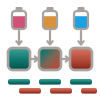
One Protein A pool, three ways to neutralize it.
Expert Solution Operations Designer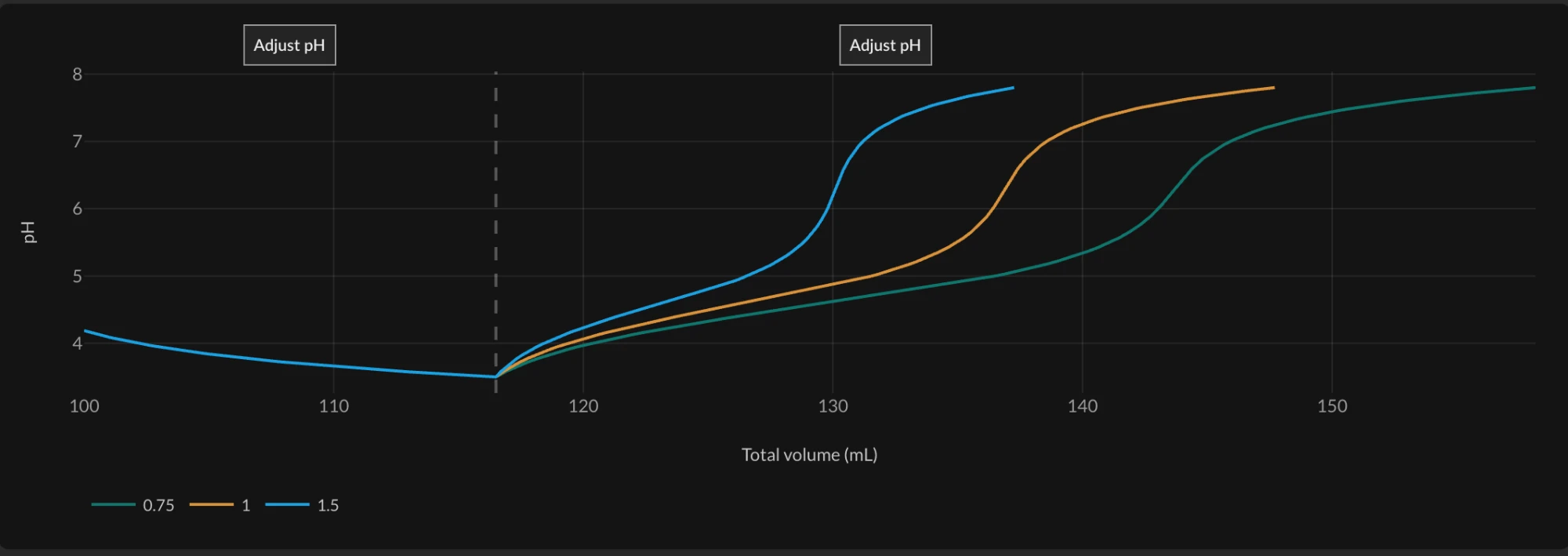
What changes when you can simulate it
Understand, experiment, scale
01 · Understand
Better understanding.
Watch the Donnan effect pull your retentate pH off target, or ionic strength shift a pKa. The mechanism is visible, so a surprise becomes something you can reason about — and explain to someone else.
02 · Experiment
Better experiments.
Ask the questions you'd never spend material on. Forty conditions sweep in about three seconds, so “what if we ran it colder” costs nothing but curiosity — and your DOE arrives with a reason behind every point.
03 · Scale
Better processes.
What you learn at 10 mL carries forward: the same solutions and the same chemistry, into skid design, buffer supply and the campaign schedule.
The assistant
Describe it in words. The numbers still come from the model.
Describe the process the way you'd describe it to a colleague, and the assistant builds the design, runs it through the simulation, and reads the result back in a sentence. The chart and the table are right there beside it, so you are never taking its word for anything.
The assistant drives the model; it doesn't do the arithmetic. Every number on screen comes from the same first-principles engine you would have driven by hand — and if you change an input, the results are flagged stale rather than left to be misread.
“50 mM phosphate with 150 mM sodium chloride at pH 7.2, made up at 4 °C”
- Buffer system
- Phosphate
- Buffer concentration
- 50 mM
- Target pH
- 7.20
- Salt
- Sodium chloride, 150 mM
- Temperature
- 4 °C
One chemistry engine · seven apps
Ask, explore, characterize
Seven different tools, not seven views of one — sharing the chemistry that has to agree between them. Each answers a question you actually have. Find the one that sounds like your week.
| App | Who it's for | The question it answers | Status |
|---|---|---|---|
 Expert Buffer Designer Expert Buffer Designer | PD · Formulation | What will this buffer's pH actually be at 4 °C instead of 25 °C — and how much has it moved? | In beta |
 Expert Solution Operations Designer Expert Solution Operations Designer | PD · MSAT | After I titrate, dilute and condition a pool — what is actually in the tank now? | In beta |
 Expert Bioreactor Designer Expert Bioreactor Designer | USP · Cell culture | How will pH control behave once the cells start making acid — and will my base addition keep up? | In beta |
 Expert Buffer Stock Blending Designer Expert Buffer Stock Blending Designer | MSAT · Facility | Can my skid actually make this buffer from the stocks I hold — and is blending it cheaper than preparing it? | Coming soon |
 Expert UF/DF Designer Expert UF/DF Designer | Formulation · DSP | Why did my retentate pH drift away from the diafiltration buffer — and what buffer should I have used instead? | Coming soon |
 Expert Chromatography Designer Expert Chromatography Designer | DSP · Purification | For a protein with this pI, where should I start the gradient — and should this be CEX or AEX? | Coming soon |
 Expert Process Designer Expert Process Designer | MSAT · Manufacturing | Across a twelve-batch campaign, do I run out of buffer or tank space — and on which day? | Coming soon |
Why you can trust the answer
Computed, not fitted
Every number comes from a charge-balance solve on the full ionic speciation — not a fixed pKa. Because it is computed rather than fitted, a molecule nobody has characterized yet is modeled as well as a familiar one, which is precisely when you have the least data and the most experiments to plan.
We check the engine against published measurements, and we say where it stops being reliable. See the science →
2.9 s
for 40 conditions, on an ordinary server — down from 20.6 s before parallelization. Fast enough that exploring costs you nothing.
Bring your process. Leave with a characterized one.
The beta runs in the browser, with each person's work in its own private workspace. It's free during the beta.