Science

Why you can trust the answer

Every number comes from a charge-balance solve on the full ionic speciation — not a fixed pKa. Because it is computed rather than fitted, a molecule nobody has characterized yet is modeled as well as a familiar one, which is precisely when you have the least data and the most experiments to plan.

Computed, not fitted

What "first principles" means here

The apps treat a solution as ions in water at chemical equilibrium. Each compound dissolves into its ions; each buffering ion can gain or lose hydrogen ions; and the pH is the one value at which every positive and negative charge balances. Salt shields charges, which shifts every pKa, and temperature moves the pKa values and water's own ionization — so both are part of the calculation, not a correction added afterwards.

The same engine runs in every app. A buffer designed in one gives the same composition in another, because there is only one chemistry.

Every number is theoretical. The models are good enough to plan with, and every app says where its model stops being reliable. Measure at the bench before you rely on a result for a process, regulatory or safety decision.

Checked against published work

We reproduce the papers you would cite

The strongest test of a model is a benchmark study it wasn't built from. We run ours against them — inputs restricted to published values, nothing tuned to the answer — and report what matches and what doesn't.

UF/DF · the Donnan effect

Bolton et al., Biotechnology Progress, 2010

An antibody diafiltered into pH 6.0 histidine buffers and concentrated to 152 g/L. Our model and the paper's own closed-form Donnan equation agree to within 0.019 pH units, with nothing fitted. In high salt we predict a shift of +0.019 where Bolton measured +0.02. In 10 mM histidine we inherit his model's known overprediction, for the reason he gives: neither model includes ions binding to the protein.

Chromatography · pH transients

Pabst & Carta, 2007

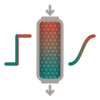
Salt steps on weak-acid cation exchangers, across four buffers and three resins, with zero fitted transport parameters. The predicted pH excursions — 1.30 to 1.35 units at 0.02 M sodium and 0.69 to 0.77 at 0.1 M — straddle the paper's reported 1.4 and 0.7. We publish the one number that doesn't match, and why.

Buffers · salt and pKa

Pezza 1996 · Bretti 2018 · Palmer 1987 · Wesolowski 1989 · Raposo 2003

Salt corrections checked against published pKa measurements: acetate; histidine, arginine, aspartate and glutamate; Tris up to 5 M sodium chloride; Bis-Tris; borate. For phosphate, acetate and borate the typical pH error is 0.02 up to 0.25 M ionic strength, 0.07 to 1 M, and 0.28 above. pKa values follow the NIST critical compilation (Goldberg et al., 2002).

Cell culture · culture shapes

Toussaint et al., 2016

Two published CHO shake-flask cultures reproduced with the Bioreactor Designer's profile knobs. That tests whether the model can take the shape of a real culture. It is not a validation of the cell model, and the app says so.

The models

One engine, built in Rust

AreaModelWhere you'll find it
Chemistry Davies, SIT and extended Debye–Hückel activity corrections; van 't Hoff pKa temperature dependence from published ΔG, ΔH and ΔCp. Buffer Designer · Solution Operations
Protein Charge and pI from amino-acid composition and side-chain pKas. Buffer Designer · UF/DF
Cell culture An energy and redox balance per gram of cells, with overflow to lactate; oxygen transfer; CO₂, bicarbonate and pH from the same chemistry; DO and pH controllers. Bioreactor Designer
Membranes Donnan equilibrium partitioning with a sieving mass balance. UF/DF · coming soon
Chromatography Steric Mass Action isotherms with pH-dependent binding; Frey coherence theory; Carta salt-step transients. Chromatography · coming soon
Scheduling Constraint programming with coupled buffer-reservoir limits. Process Designer · coming soon

Where the models stop

Each app states its limits

Every app's guide has a section on the valid range of its inputs, what its model leaves out, and how far to trust its numbers. The short version:

Fast enough to explore

2.9 s

for a 40-condition design sweep on an ordinary server — down from 20.6 s before parallelization. A 14-day bioreactor run takes a few seconds. Exploring costs you nothing.

Published

The method, in the literature

  • N. Ram & A. Ravi, "Buffer Design for Biopharmaceutical Processes: An Online Tool for Designing and Understanding Buffers," BioProcess International, 2024. Read ↗
  • N. Ram et al., "Evaluation of the Design, Development, and Performance of a Mass-Flow Based, Open-Source Buffer Manufacturing System," PDA Journal of Pharmaceutical Science and Technology 77(2):79–98, 2023. DOI ↗

More on the Buffer Stock Blending System →