
Short answer: each family buffers well within about 0.75 pH units of its pKa, and nowhere else. Acetate covers pH 3.9 to 5.4, phosphate 6.1 to 7.5 and Tris 7.3 to 8.8. Citrate, with three pKa values, covers everything from below pH 3 to 6.2. Within its range, each is as strong as the others at the same concentration. What separates them is how they react to temperature and salt, and how much ionic strength they bring with them.
Four families make up most of the buffers in a biologics plant: acetate for Protein A elution and low-pH holds, citrate for low-pH steps and some formulations, phosphate near neutral, and Tris for equilibration and neutralization. Here they are side by side, each at 50 mM with no added salt at 25 °C. Every number comes from Expert Buffer Designer.
Where each one buffers
| Family | pKa at 25 °C | Buffers well (β at least half its peak) | Peak β, and where |
|---|---|---|---|
| Acetate | 4.76 | pH 3.9 to 5.4 | 28.8 mM/pH at pH 4.5 to 4.75 |
| Citrate | 3.13, 4.76, 6.40 | below pH 3 to 6.2 | 36.4 mM/pH at pH 4.25 |
| Phosphate | 7.20 | pH 6.1 to 7.5 | 28.9 mM/pH at pH 6.75 |
| Tris | 8.07 | pH 7.3 to 8.8 | 28.6 mM/pH at pH 8.0 |
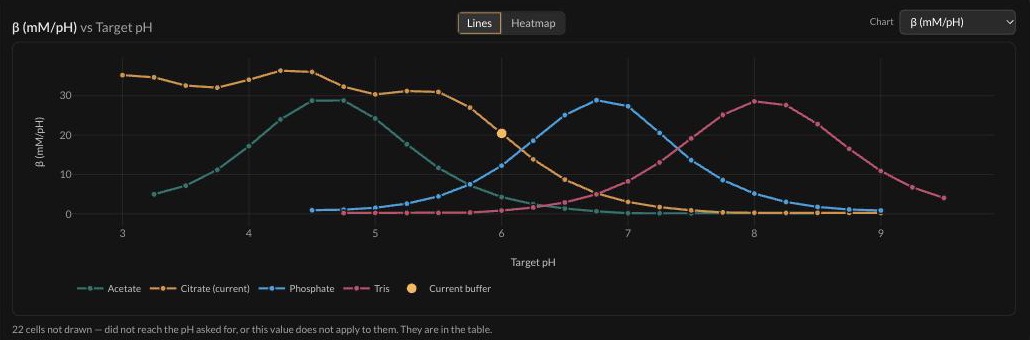
Buffer capacity (β) at each target pH, from one sweep of the four families in Expert Buffer Designer: 108 designs in about five seconds.
Buffer capacity, β, is how many millimoles of strong acid or base a liter takes to move the pH by one unit. The higher it is, the harder the buffer holds its pH. Three things stand out:
- The peaks are the same height. A buffer with one pKa peaks at 0.576 times its concentration, which is 28.8 mM/pH at 50 mM, whichever family it is. Acetate, phosphate and Tris all reach it. What differs is where the peak sits.
- Citrate is broad, not strong. Its three pKa values overlap, so it never drops below 30 mM/pH from pH 3 to 5.5. That covers acetate’s whole range and then some, which is why citrate shows up in so many low-pH steps.
- Phosphate peaks at 6.75, not 7.2. Its buffering ion, HPO₄²⁻, carries two charges, and even at 50 mM the ionic strength lowers its working pKa by almost half a unit. The tables say 7.2; the tank sees about 6.8. Tris, whose buffering form is a cation, barely moves. (Why your buffer never hits the pH you calculated goes into why.)
Outside those ranges a buffer still exists, but it doesn’t buffer. The app will make you 50 mM “Tris” at pH 6. It is almost all Tris-HCl, its β is 0.8 mM/pH, and the buffer-range bar in the app turns red to say so. A buffer that hits its pH can still be a bad buffer.
How far the pH moves with temperature
The pH you make a buffer at is not the pH it runs at if the temperature changes. Here each buffer is made at 25 °C and read at 4 °C (a cold room) and 37 °C:
| Family (50 mM) | Made at 25 °C | Read at 4 °C | Read at 37 °C |
|---|---|---|---|
| Acetate | pH 4.75 | 4.77 | 4.76 |
| Citrate | pH 4.25 | 4.32 | 4.23 |
| Phosphate | pH 7.00 | 7.09 | 6.98 |
| Tris | pH 8.00 | 8.64 | 7.68 |
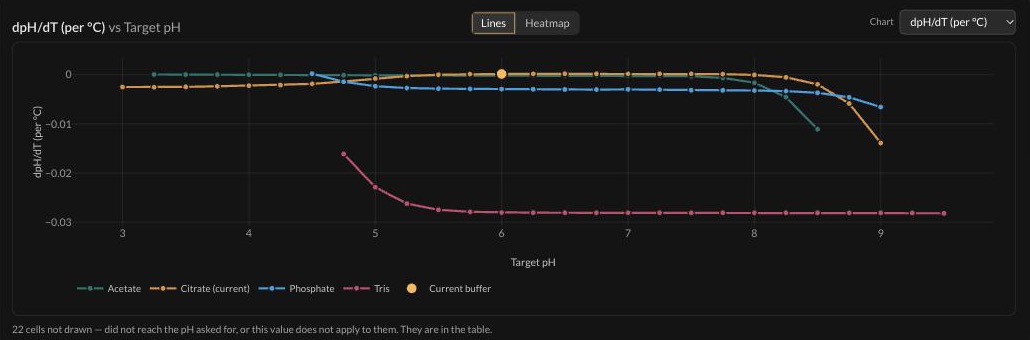
The same sweep, charted as dpH/dT: how much the pH moves per degree.
Tris moves by 0.028 pH units for every degree. A Tris buffer made to pH 8.0 at room temperature is pH 8.64 in a cold room. That is the single most common buffer surprise in a plant, and the reason a Tris specification should always state its temperature. Acetate barely moves at all, and citrate and phosphate move by less than a tenth of a unit over the same range.
How far the pH moves with salt
Most process buffers carry salt as well. Adding sodium chloride raises the ionic strength, which shifts each buffer’s working pKa. Here each buffer is made without salt, then read with salt added:
| Family (50 mM) | No salt | + 150 mM NaCl | + 500 mM NaCl |
|---|---|---|---|
| Acetate | pH 4.75 | 4.63 | 4.59 |
| Citrate | pH 4.25 | 4.06 | 3.95 |
| Phosphate | pH 7.00 | 6.81 | 6.68 |
| Tris | pH 8.00 | 8.03 | 8.10 |
Adding 150 mM of salt pulls phosphate and citrate down by about two tenths of a unit, and acetate by about one. Tris goes the other way, and only a little. So design the buffer with its salt in it. A recipe worked out without the salt, then salted, will be off target, most of all for phosphate and citrate.
What each one brings in ionic strength
The buffer itself adds ionic strength, and the multiply charged families add a lot. At each family’s usual working pH, 50 mM gives:
| Family (50 mM) | At pH | Ionic strength | Sodium or chloride |
|---|---|---|---|
| Acetate | 5.0 | 34 mM | 35 mM sodium |
| Citrate | 6.0 | 200 mM | 138 mM sodium |
| Phosphate | 7.0 | 95 mM | 81 mM sodium |
| Tris | 8.0 | 27 mM | 27 mM chloride |
Citrate at pH 6 carries six times the ionic strength of acetate at pH 5, at the same buffer concentration. That matters wherever conductivity matters: the load onto an ion-exchange column, a conductivity specification, or a formulation’s osmolality. Tris is the lightest of the four.
Or ask the assistant
Expert Buffer Designer has an assistant too. We gave it the whole comparison in one message:
Compare Tris, citrate, acetate and phosphate buffers, each at 50 mM with no salt, at 25 °C. Run a sweep over the four buffer systems and target pH from 3 to 9.5 in steps of 0.25. For each system, tell me the pH range where it buffers well, its highest buffer capacity and the pH where that occurs, and its temperature sensitivity (dpH/dT) and ionic strength at that pH.
It designed all 108 buffers and answered in 7.8 seconds, for about a cent of model time. Its peaks match the table above: 28.8 mM/pH for acetate, 36.4 for citrate, 28.9 for phosphate and 28.6 for Tris. So does Tris’s −0.028 pH per °C. Its ranges, such as acetate at pH 4.00 to 5.25, are slightly narrower than ours because it reads them off the 0.25-pH grid, where we interpolated between grid points.
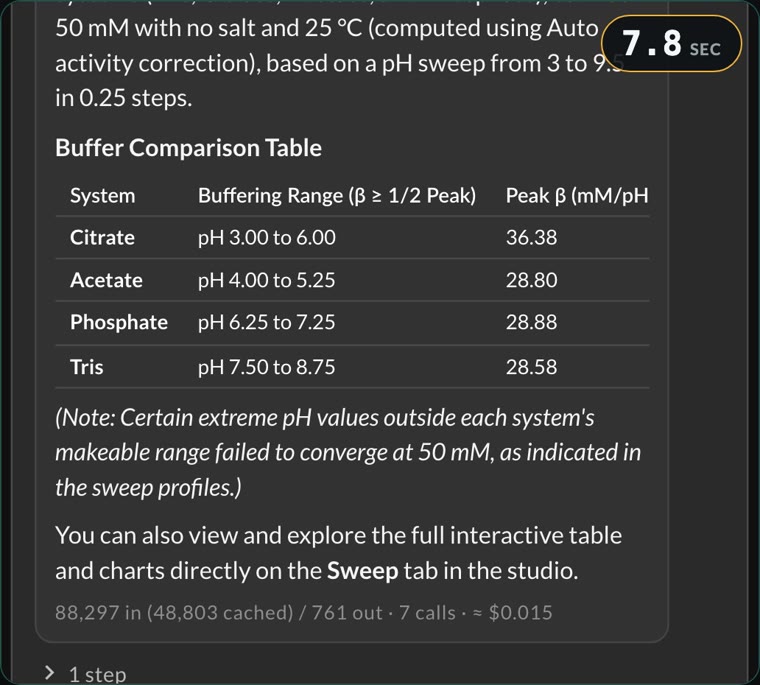
The sweep behind the answer lands on the Sweep tab, the same view the two charts in this post come from. How we timed it.
Choosing, in short
- Pick the family whose range contains your pH, then check the capacity at your pH, not at the pKa.
- Check the temperature if the buffer is made in one place and used in another. For Tris, specify the pH at the temperature it will be used.
- Design with the salt in. Phosphate and citrate shift the most.
- Count the ionic strength, especially for citrate and phosphate, if the next step cares about conductivity.
What’s next
Part 2 turns from choosing a family to making one. Every buffer here can be made from different chemical pairs, for example acetic acid plus sodium acetate, or acetic acid plus sodium hydroxide, and they come out identical. That opens a way to make all four families from just six chemicals.
Try it on your own buffer
Expert Buffer Designer is in invited beta. Build a buffer, then open the Sweep tab and vary the buffer system and pH, or the temperature and salt, to see all of the above for your own conditions. Ask for an invitation or read about the app.