
Short answer: a buffer is defined by what ends up in the solution, not by which bottles it came from. Fifty millimolar acetate at pH 5.0 made from acetic acid and sodium acetate is the same solution as one made from acetic acid and sodium hydroxide: same pH, same sodium, same ionic strength, same buffer capacity. Choose the pairs with that in mind, and six chemicals make every acetate, citrate, phosphate and Tris buffer, where the textbook pairs need eight.
In part 1 we compared the four families. Here we make each one two ways, and check in Expert Buffer Designer that the results match.
Two ways to make each buffer
Every buffer is a weak acid and its conjugate base, in a ratio set by the pH. You can weigh out both forms, the conjugate pair. Or you can start from one form and convert part of it with a strong base or acid, the titration route. The app designs both.
| Buffer | Conjugate pair (g/L) | Titration route (g/L) |
|---|---|---|
| 50 mM acetate, pH 5.0 | Acetic acid 0.88 + sodium acetate 2.89 | Acetic acid 3.00 + sodium hydroxide 1.41 |
| 25 mM citrate, pH 6.0 | Citric acid 0.60 + trisodium citrate 5.64 | Citric acid 4.80 + sodium hydroxide 2.62 |
| 50 mM phosphate, pH 7.0 | Sodium phosphate monobasic 2.30 + dibasic 4.38 | Phosphoric acid 4.90 + sodium hydroxide 3.23 |
| 50 mM Tris, pH 8.0 | Tris base 2.78 + Tris-HCl 4.27 | Tris base 6.06 + hydrochloric acid 0.99 |
All at 25 °C, no added salt, per liter, and all anhydrous weights. Trisodium citrate is usually bought as the dihydrate, which is 6.43 g/L. In practice the sodium hydroxide and hydrochloric acid go in as solutions: 0.99 g of hydrochloric acid is 27.1 mL of 1 M HCl. The phosphoric acid route is built with custom compounds in the app; its built-in Phosphate-NaOH system starts from the monobasic salt instead, with the same result.
And what ends up in the solution
| Buffer | Route | pH | Sodium or chloride | Ionic strength | β (mM/pH) |
|---|---|---|---|---|---|
| Acetate, pH 5.0 | Conjugate pair | 5.00 | 35.3 mM sodium | 33.5 mM | 24.2 |
| + sodium hydroxide | 5.00 | 35.3 mM sodium | 33.5 mM | 24.2 | |
| Citrate, pH 6.0 | Conjugate pair | 6.00 | 65.6 mM sodium | 98.5 mM | 14.3 |
| + sodium hydroxide | 6.00 | 65.6 mM sodium | 98.5 mM | 14.3 | |
| Phosphate, pH 7.0 | Conjugate pair | 7.00 | 80.8 mM sodium | 94.5 mM | 27.3 |
| + sodium hydroxide | 7.00 | 80.8 mM sodium | 94.5 mM | 27.3 | |
| Tris, pH 8.0 | Conjugate pair | 8.00 | 27.1 mM chloride | 27.1 mM | 28.6 |
| + hydrochloric acid | 8.00 | 27.1 mM chloride | 27.1 mM | 28.6 |
Identical, line for line. It has to be: the solution holds the same total acetate and the same total sodium either way, and the charge balance leaves only one pH they can sit at. Where the sodium came from doesn’t enter into it.
The sweep checks this across the whole range, not just at one pH. We swept eight buffer systems, each family’s conjugate pair and its pH-adjusted twin in the app (Acetate and Acetate-NaOH, and so on), across pH 4.5 to 8.5: 71 designs in about six seconds. At every pH, each pair of routes matched to within 0.03 mM of sodium or chloride and 0.001 pH units.
Or ask the assistant
The assistant in Expert Buffer Designer will make both routes for you. We asked:
With no salt at 25 °C, compare these pairs: 50 mM acetate pH 5.0 from Acetate (acetic acid + sodium acetate) vs Acetate-NaOH; 25 mM citrate pH 6.0 from Citrate vs Citrate-NaOH; 50 mM phosphate pH 7.0 from Phosphate vs Phosphate-NaOH; 50 mM Tris pH 8.0 from Tris vs Tris-HCl. For each, give the chemicals and grams per liter, and confirm whether the final pH, ionic strength, sodium or chloride, and buffer capacity are the same.
It designed all eight in 3.2 seconds, for under a cent. It gave the grams for each route and put all eight side by side on the Compare tab, where the two acetates line up exactly: pH 5.00, 33.5 mM ionic strength, 24.2 mM/pH.
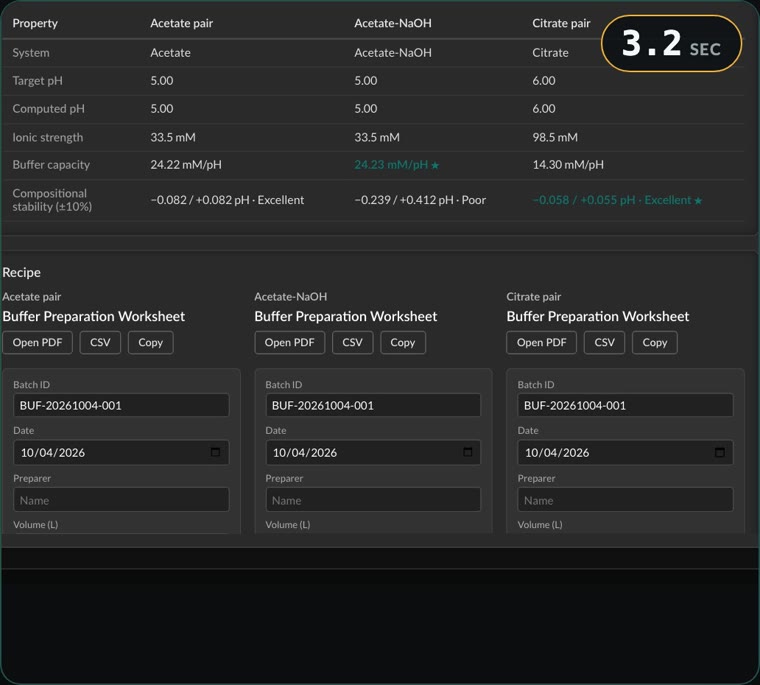
The Compare tab adds one thing the two routes don’t share: how forgiving they are. Its compositional-stability row varies each chemical by 10%. The acid-and-salt acetate moves by ±0.08 pH, rated Excellent. The NaOH route moves by up to 0.41, rated Poor, because its pH rests on how much base goes in. That is the dosing-accuracy point below, in numbers.
How we timed it, and three more questions.
Six chemicals instead of eight
Line up what each approach puts in the warehouse:
| Conjugate pairs | Titration routes | |
|---|---|---|
| Acetate | Acetic acid, sodium acetate | Acetic acid |
| Citrate | Citric acid, trisodium citrate | Citric acid |
| Phosphate | Sodium phosphate monobasic and dibasic | Phosphoric acid |
| Tris | Tris base, Tris-HCl | Tris base |
| Shared | Sodium hydroxide, hydrochloric acid | |
| Total | 8 chemicals | 6 chemicals |
And the plant almost certainly holds sodium hydroxide and hydrochloric acid already, for cleaning and pH adjustment. So the four families really cost four new raw materials: one acid or base per family. Every one of those is a specification, a supplier to qualify, incoming testing, a certificate of analysis to review, a shelf to manage, and a hydrate form to get right. Sodium phosphate dibasic alone is sold anhydrous, as the dihydrate, the heptahydrate and the dodecahydrate, and the heaviest weighs two and a half times the lightest for the same phosphate.
When the conjugate pair is still the better choice
The titration route isn’t free:
- Handling. Concentrated sodium hydroxide and hydrochloric acid are corrosive, and dissolving or diluting them gives off heat. Conjugate salts are solids you weigh and dissolve.
- Dosing accuracy. With a conjugate pair, the pH follows from two weighings. With a titration route, it follows from how much strong base or acid goes in, so it rests on the stock concentration and the dispensing. Many sites titrate to the pH instead, which adds a measurement step and moves the sodium with it.
- Validated recipes. A buffer that is already registered with a set of raw materials may not be worth changing.
So it’s a trade: fewer raw materials against a little more care at the make-up step. For a new platform, or a plant rationalizing its raw-material list, it is worth asking the question for every buffer.
Going further
The same thinking works across families. Tris base can serve as the base for acetate, citrate or phosphate in place of sodium hydroxide, giving Tris-acetate or Tris-phosphate. Those are different buffers, with Tris in place of sodium, but they can bring the chemical list down further still. Expert Buffer Designer lists these pairings alongside the classic ones, so you can compare them in the same way.
Try it on your own buffers
Expert Buffer Designer is in invited beta. Choose a buffer system and its pH-adjusted twin, such as Acetate and Acetate-NaOH, or switch to custom compounds and start from the acid alone. The Recipe tab gives the grams for each. Ask for an invitation or read about the app.